
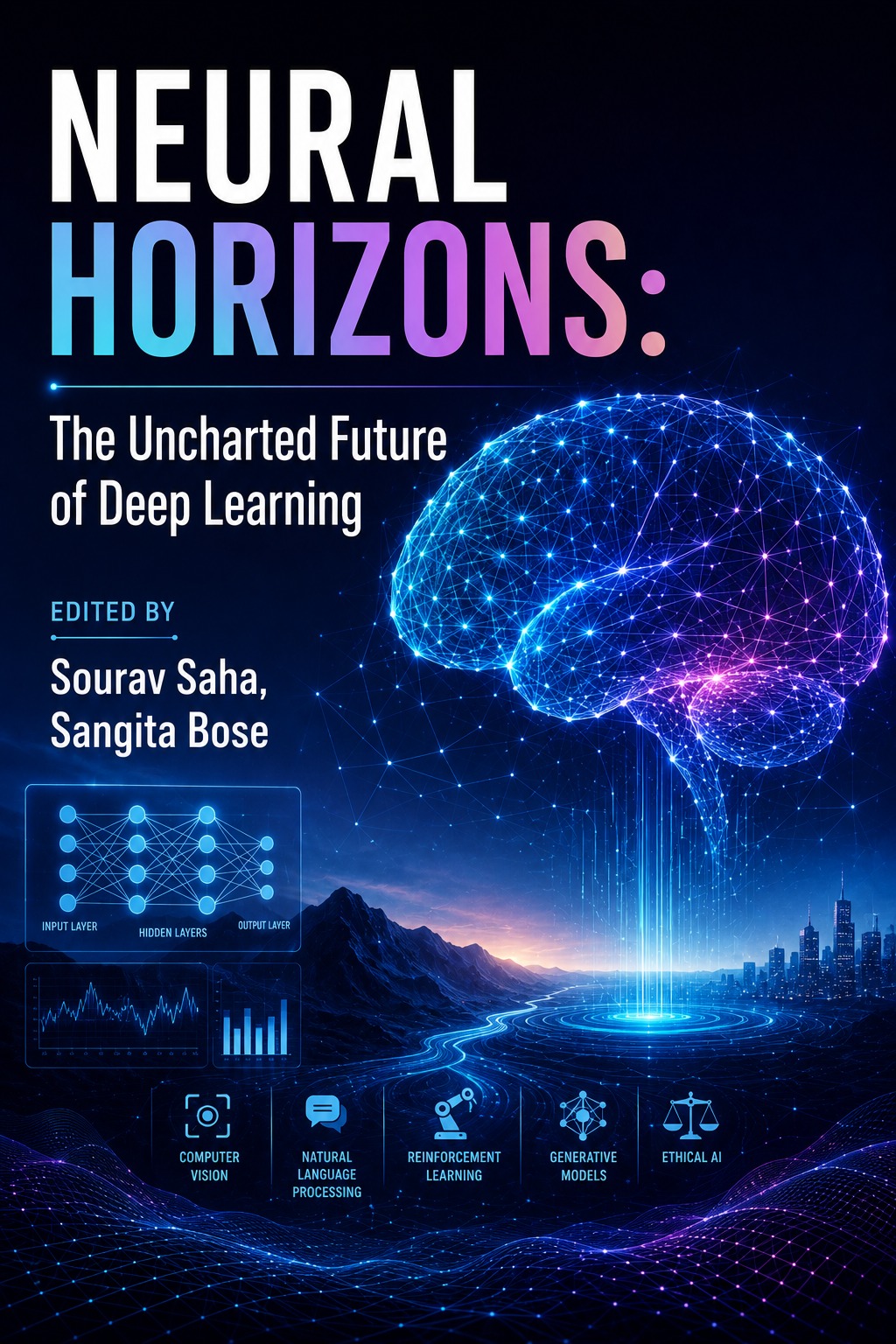
Published 2026-05-27
Keywords
- Deep Learning,
- Artificial Intelligence,
- Neural Networks,
- Machine Learning,
- Convolutional Neural Networks
- Recurrent Neural Networks,
- Generative Adversarial Networks,
- Transformers,
- Interpretability,
- Federated Learning ...More
How to Cite
Copyright (c) 2026 Swami Vivekananda University Press

This work is licensed under a Creative Commons Attribution-NonCommercial 4.0 International License.
Abstract
Deep learning, a subset of machine learning, has emerged as a revolutionary force in the fields of artificial intelligence, data science, and numerous real-world applications. Rooted in artificial neural networks, deep learning enables machines to process vast amounts of data, learn complex patterns, and make human-like decisions with remarkable accuracy. This paper provides an in-depth review and analysis of deep learning, exploring its foundational principles, key architectures, training methodologies, and significant breakthroughs. We examine state-of-the-art techniques such as convolutional neural networks (CNNs), recurrent neural networks (RNNs), generative adversarial networks (GANs), and transformers, which have transformed industries ranging from healthcare and finance to autonomous systems and natural language processing. The discussion extends to the challenges associated with deep learning, including computational costs, interpretability, data dependency, and ethical concerns. Additionally, we analyze the latest trends and potential future directions in the field, including advancements in neuromorphic computing, federated learning, and energy-efficient AI models. By synthesizing knowledge from diverse research contributions, this paper aims to provide scholars, practitioners, and enthusiasts with a comprehensive understanding of deep learning, its current landscape, and its future potential.
DOI - https://doi.org/10.65525/SVUP.9788199778009.2026.195-200